CARE
From a patient’s words to clinical context.
Discovery & design lead · Mobile & web · 3 monthsThe symptom cycleReflect
A moment for yourself.
A weekly reflection begins alongside the updates you’ve already shared.
- Headache
- Acne
- Nausea

Reflect, a patient check-in prototype. The recording moves from the reflection history to a guided video recording with the prompt “How are you feeling physically?”, while recognized symptom terms appear: Headache, Acne and Nausea.
Remote monitoring
Between doctor visits, patients in cancer research kept track of their symptoms and treatment side effects every day. I designed the platform for that remote monitoring, from a patient’s own words to the care team’s review.
Product discovery and design lead in AstraZeneca’s digital health oncology division. I interviewed patients, doctors, nurses and research staff, and directed bi-weekly design sprints, each testing specific hypotheses with users by prototype.
The evidence behind ePROs · Published research
Of paper diary entries were actually made on schedule, though patients reported 90%. With an electronic diary, 94% were. Stone et al., BMJ, 2002, in adults with chronic pain.
At worst, the share of patient-reported symptoms missing from physicians’ records, across three randomized cancer trials (40.7% to 74.4%, by symptom). Di Maio et al., Journal of Clinical Oncology, 2015.
Months on chemotherapy, on average, for patients who self-reported symptoms with alerts to their nurses, against 6.3 with usual care. Basch et al., Journal of Clinical Oncology, 2016.
Why it matters
Patients report symptoms earlier than clinicians record them.
A finding of Dr. Ethan Basch, CARE’s clinical advisor, who led the development of PRO-CTCAE, the National Cancer Institute’s patient-reported measure of side effects (JNCI, 2009; 2014).
In his randomized trials, patients who reported their symptoms made fewer emergency visits and declined more slowly (JCO, 2016; Nature Medicine, 2025). An early survival gain (JAMA, 2017) did not repeat in the larger PRO-TECT trial.
The FDA now recommends that registration trials of cancer drugs collect symptomatic side effects from patients (2024). AstraZeneca’s Evinova names the gap CARE was designed for: “between clinic visits, when symptoms of toxicity often emerge but go unnoticed.”
Published findings on ePRO symptom monitoring, not results of CARE.
Voice symptom tracking
Patients can track their symptoms just by speaking in plain language.
Reflect
Start with the patient’s own words.
We explored LLM extraction of symptom keywords from a short spoken reflection, alongside PPG sensing that reads blood flow through the skin while the patient speaks.
I designed the interaction around it: permissions, recording prompts, time-limit cues, and the choice to continue, save or delete a reflection.
Every moment around
the recording, specified.
Permission, interruption, clarification, draft recovery and the recipient’s review.

The symptom journey
From a reflection to the people who follow it.
My user flow for Reflect: record, clarify, share and review, with a way out of every interruption.
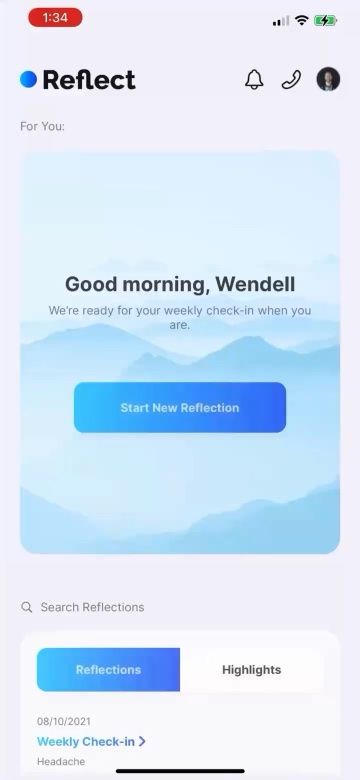 Home
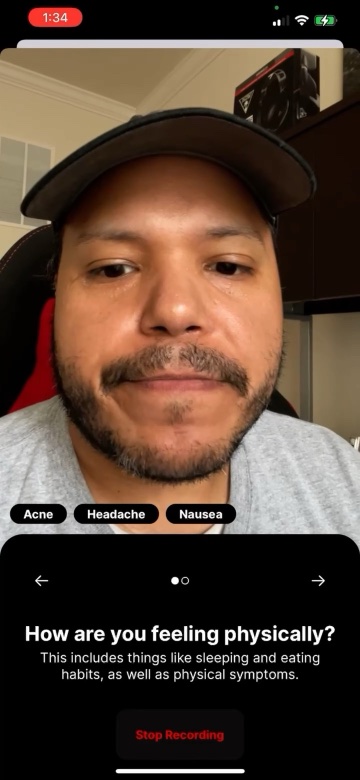 Recording
Steps from my original user flow. Screens are frames of the Reflect prototype recording.
Concept testing
Ideas, tested with patients.
Weekly insights, symptom stories and pain-management content. Each concept was tested to learn which presentations felt most useful and least overwhelming.
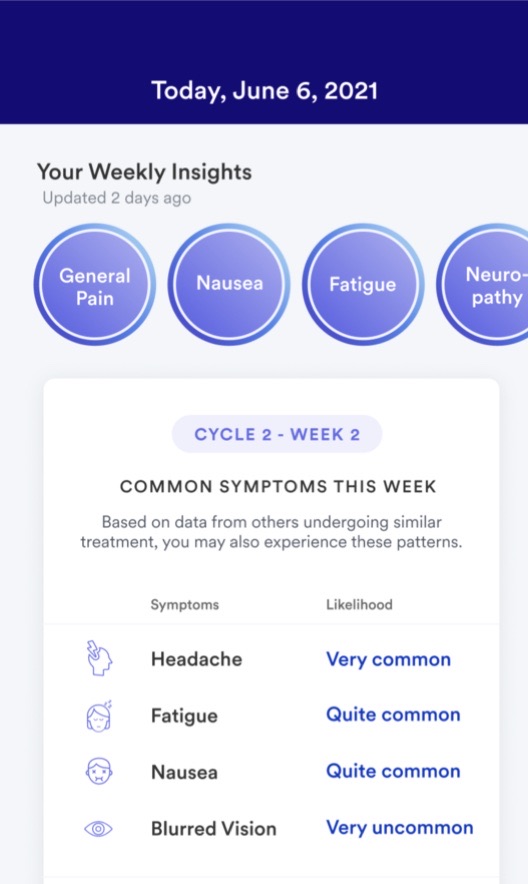
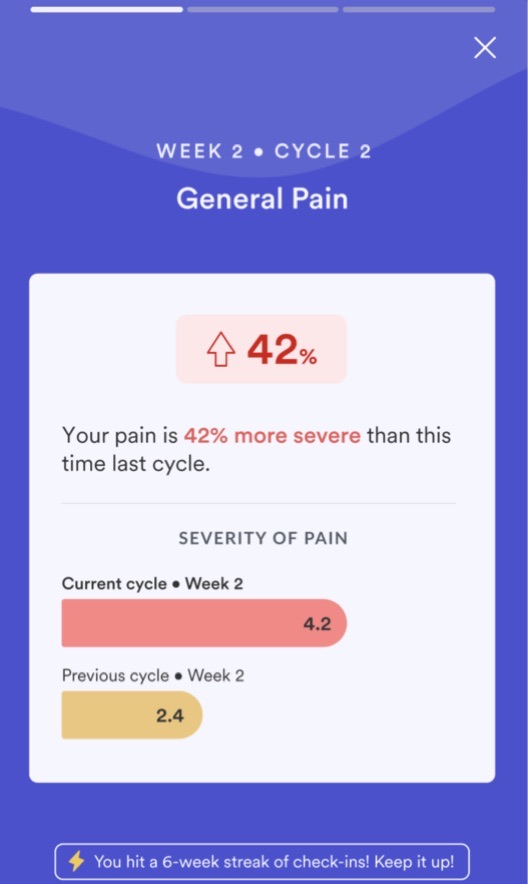
Patient-reported outcomes
Make a symptom history understandable.
Between visits, patients tracked their symptoms and treatment side effects. The design question was which information helps someone understand their experience without overwhelming them.
- 1
The cycle
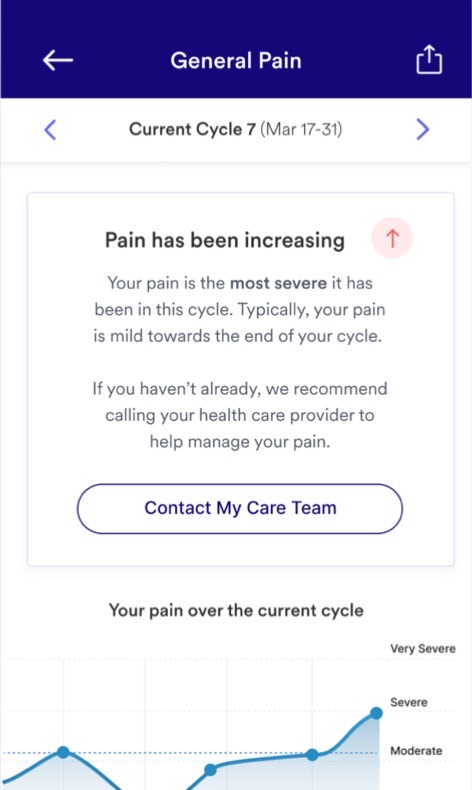
Symptoms read against the patient’s own treatment cycle.
- 2
The pattern
Each report on a five-step severity scale, against the last cycle.
- 3
The next step
A plain-language insight, and a direct line to the care team.
Rebuilt in code from my original design. Names, dates and readings are prototype data.
Current Cycle 7 (Mar 17-31)
Pain has been increasing
Your pain is the most severe it has
been in this cycle. Typically, your pain
is mild towards the end of your cycle.
If you haven’t already, we recommend
calling your health care provider to
help manage your pain.
Your pain over the current cycle
Thoughtful design can make clinical research more humane, and produce better data.
Outcome
A specified workflow across patient and clinician.
I brought recording, symptom clarification, interruption and clinical review into one documented interaction model. The flows and annotated states gave the team a concrete account of how a patient update moves through the experience, including the moments when someone needs to pause or change course.
Designing for both journeys ensured rich data capture for the cancer research team, while giving patients a low-impact way to take part in the time they actually had.
Credits
- Role
- Product discovery, design leadership, interaction design, user research, design sprints
- Clinical advisor
- Dr. Ethan Basch
- Worked with
- Clinical research team, patients and oncologists, engineering, product management
- Research
- Interviews with patients, doctors, nurses and research staff
- Organization
- AstraZeneca, digital health oncology R&D
- Platform
- Mobile and web, over three months
- Tools
- Figma, FigJam, Miro, Sketch
Screens and recordings are my original prototypes. Names, readings and figures inside them are prototype content, not patient data or results. The evidence figures are published research on ePRO symptom monitoring, not outcomes of CARE.
References
- Stone et al., 2002
- Patient non-compliance with paper diaries. BMJ 324:1193–1194.
- Basch et al., 2009
- Adverse symptom event reporting by patients vs clinicians: relationships with clinical outcomes. JNCI 101:1624–1632.
- Basch et al., 2014
- Development of the NCI’s patient-reported outcomes version of the CTCAE (PRO-CTCAE). JNCI 106:dju244.
- Di Maio et al., 2015
- Symptomatic toxicities experienced during anticancer treatment: agreement between patient and physician reporting in three randomized trials. JCO 33:910–915.
- Basch et al., 2016
- Symptom monitoring with patient-reported outcomes during routine cancer treatment: a randomized controlled trial. JCO 34:557–565.
- Basch et al., 2017
- Overall survival results of a trial assessing patient-reported outcomes for symptom monitoring during routine cancer treatment. JAMA 318:197–198.
- Basch et al., 2025
- Symptom monitoring with electronic patient-reported outcomes during cancer treatment: final results of the PRO-TECT cluster-randomized trial. Nature Medicine 31:1225–1232.
- U.S. FDA, 2024
- Core Patient-Reported Outcomes in Cancer Clinical Trials. Guidance for industry.
- Evinova, AstraZeneca
- Unified Trial Solution: remote patient monitoring. evinova.com, accessed November 2026.