
- USCIS
- ICE
- CBP
- External
From fragmented evidence to person-centric adjudication.
- Client
- USCIS / DHS
- Role
- Craft Lead, Interaction Design
- Contract
- Key Personnel
- Duration
- 6 months
System names and colors from our research matrix. The applicant is the design’s fictional sample record. Illustrative motion.
Summary
CIS 2 is the identity system USCIS adjudicators use to verify applicants and review their history. We turned fragmented, paper-heavy casework into one person-centric view of the evidence.
Key Personnel on the contract and Craft Lead for interaction design. I led six designers across four work streams, stayed hands-on with the product model and UI patterns, and represented our team in every leadership meeting with the government client.
The scale of CIS 2
Users of CIS 2
Applications processed a day, roughly
Systems touching adjudication, across USCIS, ICE, CBP and outside agencies
Research to delivery
Go where the work happens.
- On site
Where adjudication actually happened
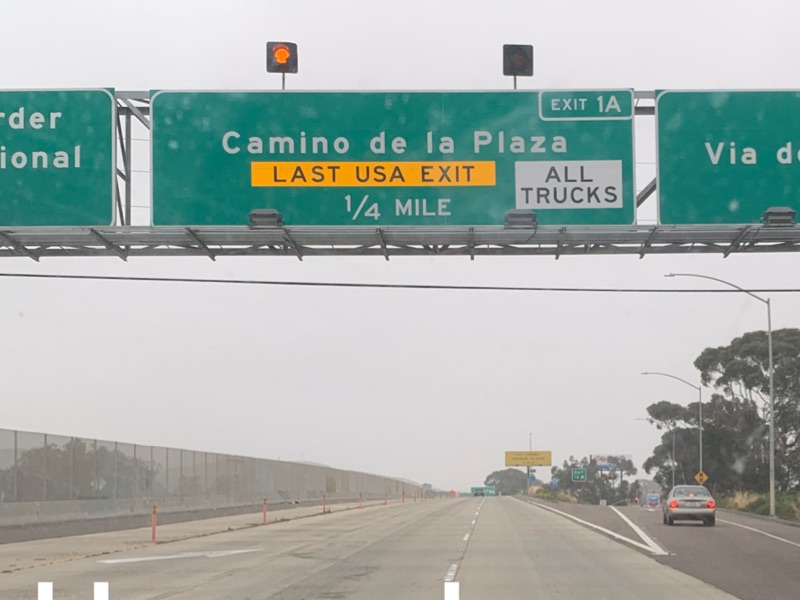
Ports of entry on the U.S.-Mexico border and service centers across the country, from San Ysidro to Vermont. We shadowed adjudicators, watched intake and ran over 100 interviews.
- On paper
A form moved through people, paper and queues
Case files were bundled, routed, stored, pulled, scanned and reviewed by hand, through intake, sorting, adjudication, decision and exception loops.

- In systems
The same person, split across systems
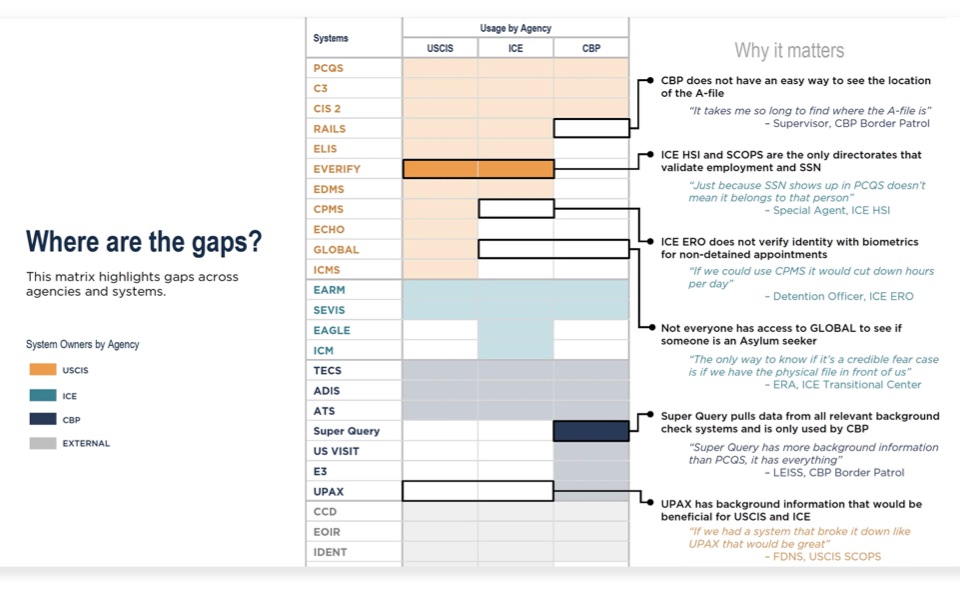
We mapped every system touching adjudication. Some were used for a single data point; some agencies lacked data that would change their work.
- Between people
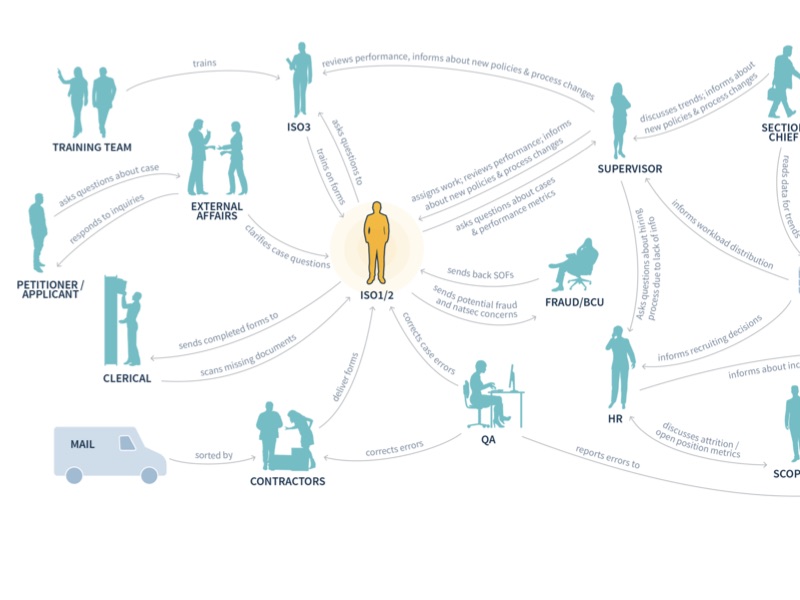
Information moved through relationships
Supervisors, records teams, section chiefs, external affairs and other agencies shaped how evidence was requested, trusted, escalated and corrected.
- With users
Test the model before the interface
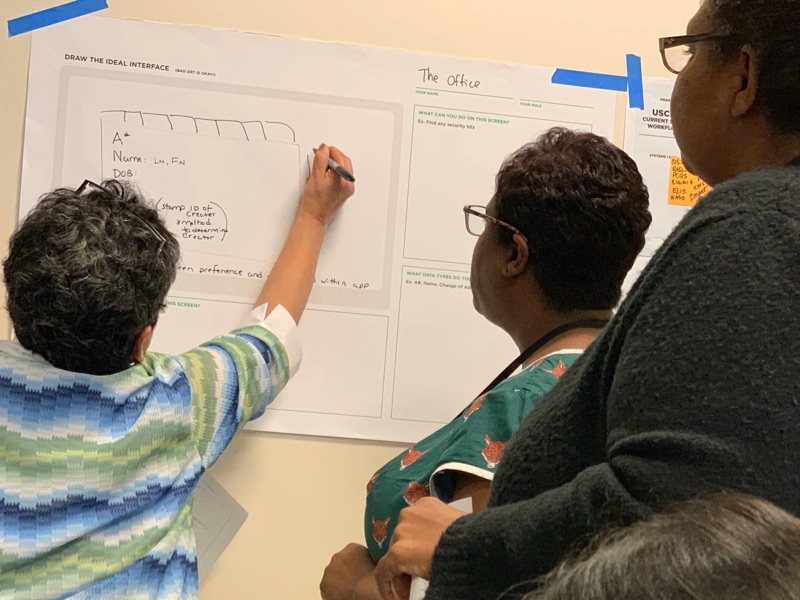
Sixteen design sprint weeks, each on a theme from research, with users at least twice a week. Workshops, sketches and lightning demos tested what belonged together.
It takes me so long to find where the A-file is.
Where are the gaps?
Officers didn’t need another place to check. They needed one coherent view.
- 01
Where is the file?
CBP had no easy way to see where a person’s A-file was.
- 02
Who can verify it?
Only ICE HSI and SCOPS validated employment and SSN. ICE ERO didn’t verify identity with biometrics for non-detained appointments.
- 03
Who can see it?
Not everyone could reach GLOBAL to learn whether someone was an asylum seeker, and UPAX held background USCIS and ICE could use.
The product model
Make the person the organizing unit. Not the form, the receipt number, the source system or the office queue.
The person-centric record
One A-number search. The officer’s whole working picture of a person.
Biographic data, biometrics, aliases, addresses, relationships, cards, petitions, encounters and checks, organized around the person rather than the form, the receipt number or the source system.










Am I looking at the right person?
The top of the record is a fast identity snapshot, organized around one A-number.
Rebuilt in code from my CIS Mod and PCIS designs. It plays on its own.
Identity resolution
Linking two identities is a consequential decision. The interface makes it explicit.
Search broadly, compare candidates and see exactly which values match. Then choose the primary values, keep the alternates, give a reason and attach the evidence.
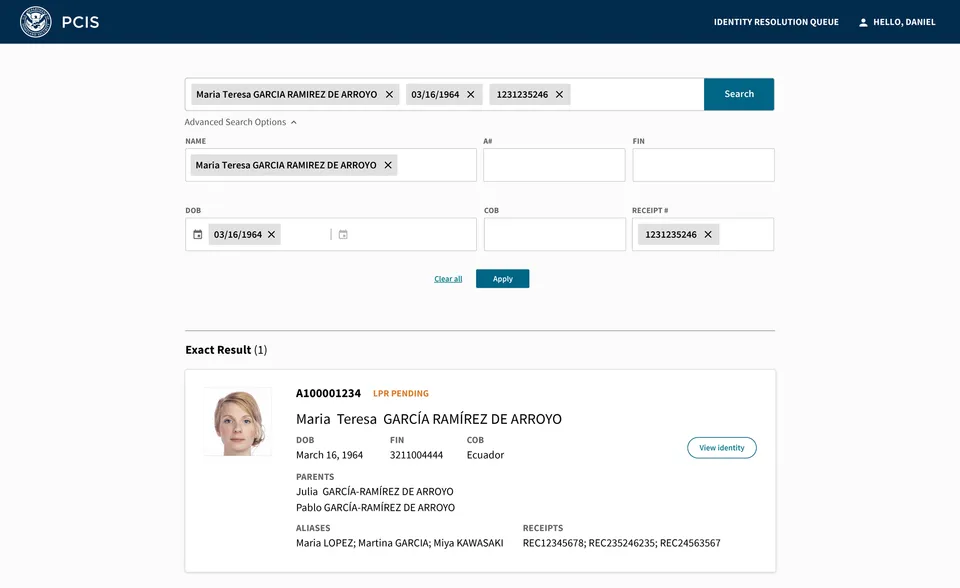 Exact and similar results
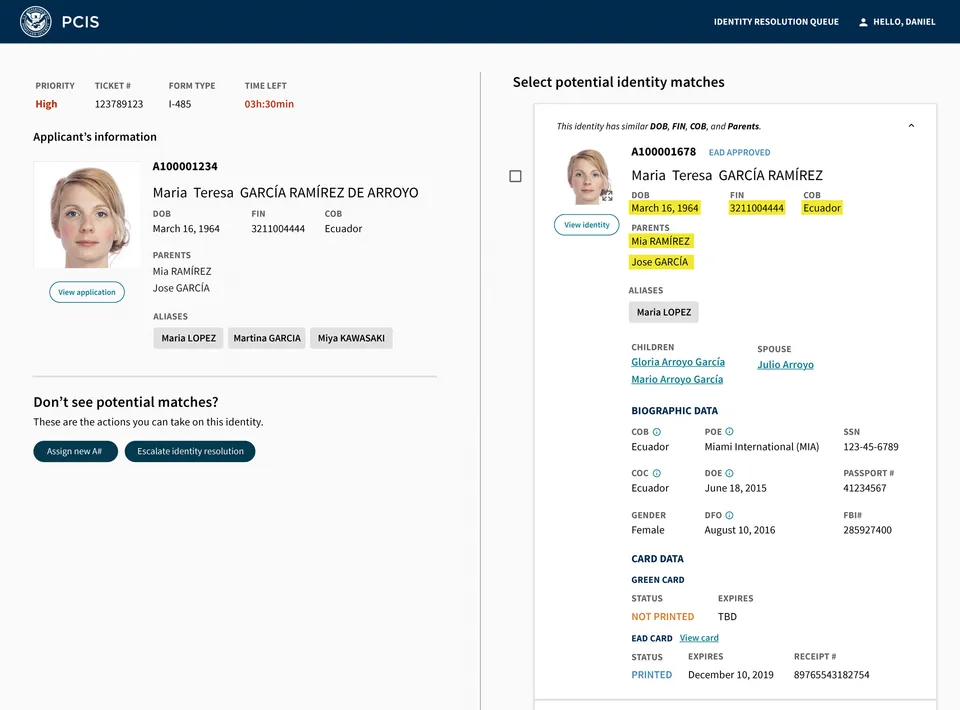 Potential matches
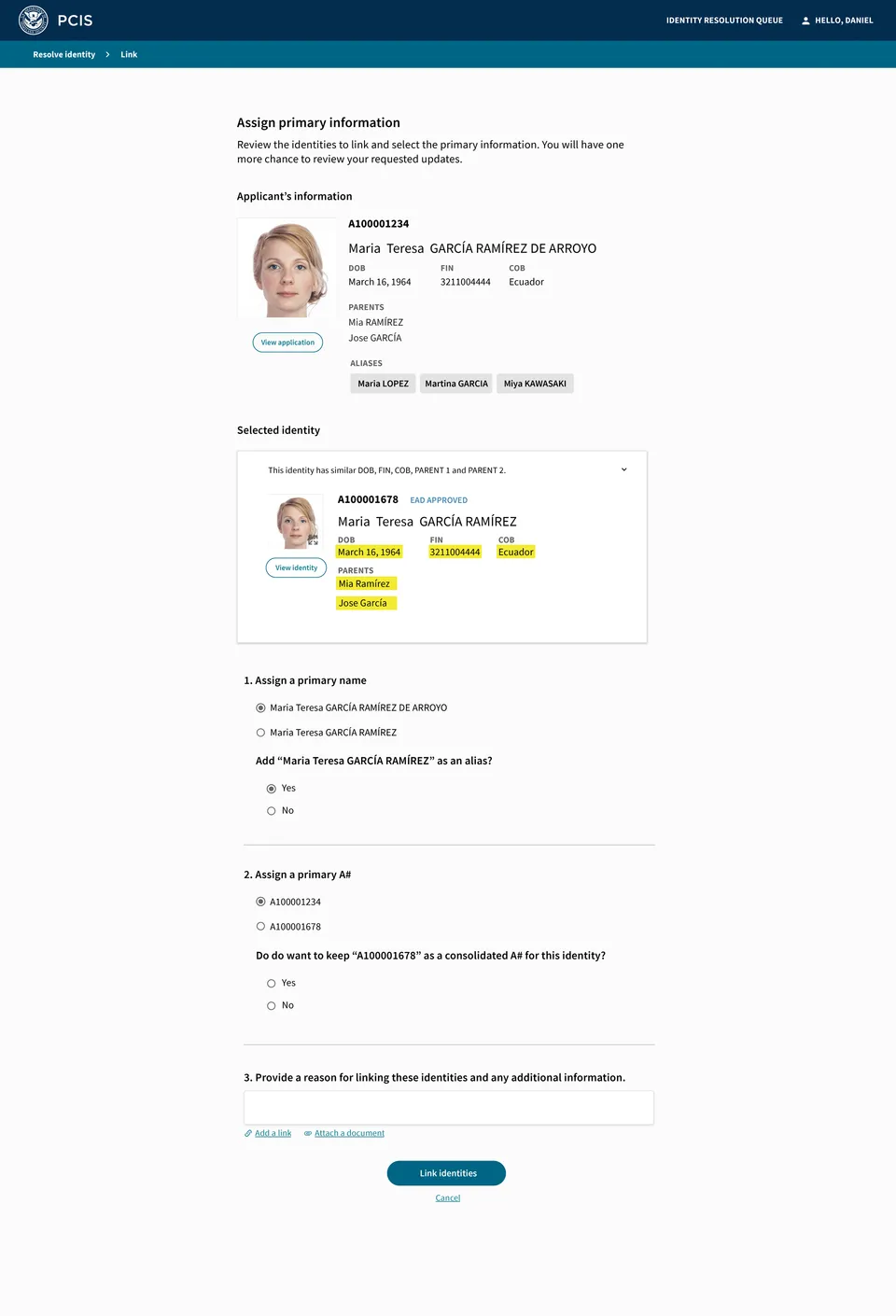 Assign primary information
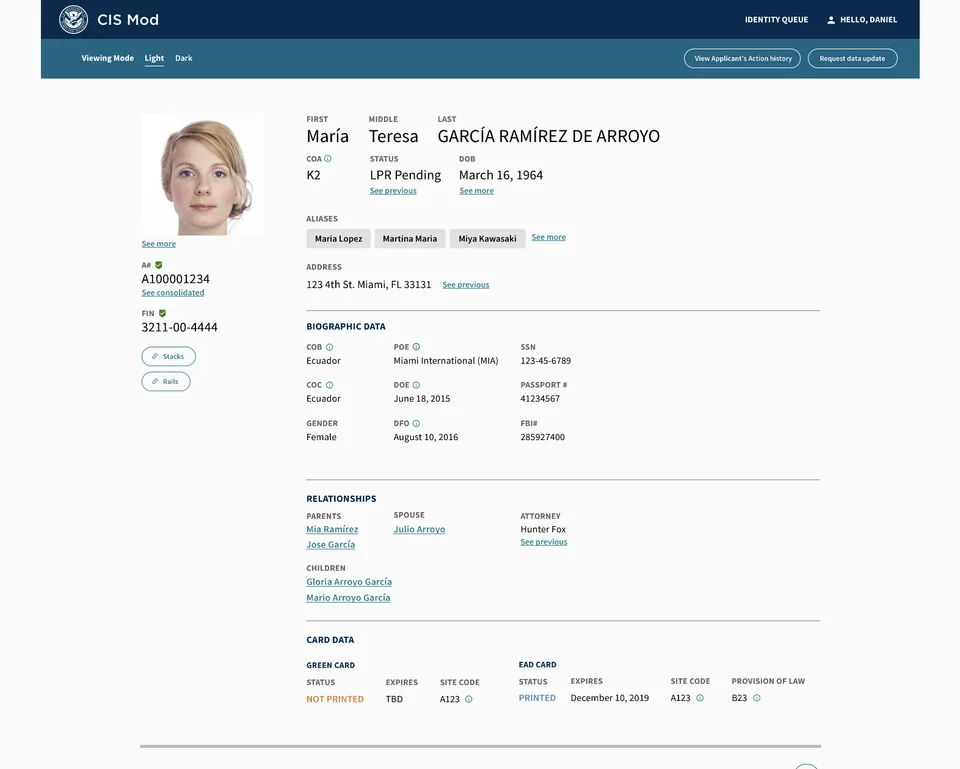 The person-centric record
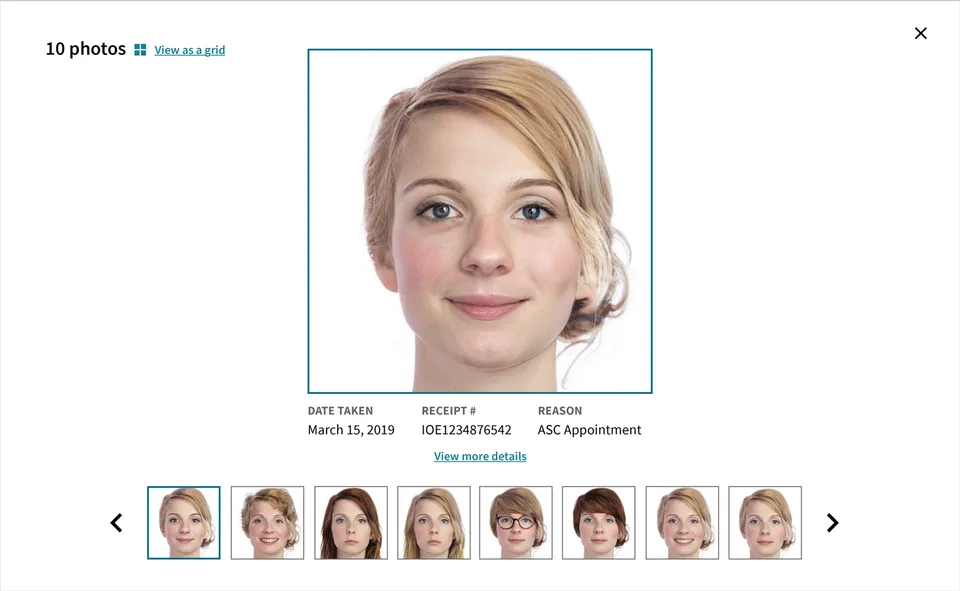 Photo history
Screens from my PCIS and CIS Mod designs. Sample data is fictional, as in the originals.
Delivery
The challenge wasn’t removing complexity. It was making it navigable.
We bridged the existing evidence systems instead of pretending they would disappear. Document images, physical file locations and historical records stay one link away from the decision.
I helped translate the model into rules engineering could build: conditional content, modal behavior, status and history, filtering, and role- and attribute-based access with audit lineage. That documentation carried what we learned in the field into product and engineering decisions.
Credits
- Role
- Key Personnel · Craft Lead, Interaction Design
- Client
- USCIS, Department of Homeland Security
- Duration
- 6 months
- Team
- 1 design lead, 4 interaction designers, 1 visual designer, 1 business designer
- Work
- Field research, service design, identity and case-management UX, RBAC / ABAC, delivery documentation
- Stakeholders
- USCIS, ICE, CBP
Every screen’s data is the designs’ fictional sample, as in the originals. The research images are the team’s originals under a slow camera. The opener’s motion is illustrative; its system names and colors come from our research matrix.